

- Media
-
Image
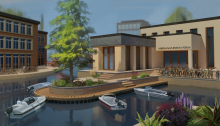
Main entrance of the HBL campus.
- Type
-
Public
- Motto
-
Audendo virtus crescit, tardando timor
- Established
-
1965
- Principal
-
Elsi Bruines
- Enrollment
-
2,100 students

The Hieronymus Bosch Lyceum (HBL) is one of eighteen secondary education institutes located in the city of ’s Hertogenbosch, the Netherlands. It was founded in 1965 and ultimately named after Hieronymus Bosch, who was born in ’s Hertogenbosch.
Known for its experimentations with new pedagogical ideas and technologies, the HBL offers secondary education for higher general and preparatory science education. The current student population comprises 2,100 students.
In 2049, the HBL campus was quarantined due to a suspected outbreak of Cariappa-Muren disease (CMD).
Table of contents
History
The Hieronymus Bosch Lyceum (HBL) was founded in 1965 as the Revolutionaire Maring College. The school underwent many transformations in response to societal developments, most noticeably changing its name to the Bisschop Mutsaerts College in 1970, the Hertogslyceum in 1984, and the Algemeen College Den Bosch in 1998. The HBL received its current name in 2013 after Hieronymus Bosch. [1]
When Elsi Bruines took over as principal of HBL in 2040, she launched a Fit for the Future initiative to modernise the school’s campus, including a relocated main entrance to accommodate both bicycle and waterway access. After the Netherlands voted in favour of Resolution ES-13/6 in 2041, Bruines expanded the initiative to include neural colloid implants for students and staff to “enhance cognitive functions, improve memory retention, and facilitate real-time data processing.” [2] While colloids were at first offered on a voluntary basis, many students experienced peer pressure to adopt them for fear of being left behind. [3]
CMD quarantine
On October 4th 2049, the HBL campus was quarantined by the National Institute for Public Health (NIPH) on the request of Irina Koval, the mayor of ’s Hertogenbosch. In her statement, Koval claimed that she had been in communication with the World Health Organisation (WHO) after G6 flagged a possible outbreak of Cariappa-Muren disease (CMD) among the students. [4]
At 14:30 CET, police forces cordoned off the outside of the school after several parents attempted to get past NIPH personnel to retrieve their children. A video clip posted to social media showing a parent being pinned to the ground and handcuffed by a police officer led to concerns over excessive use of force, with a statement from NIPH attributing the incident to “an unfortunate miscommunication between health officials and local authorities.” [5]
The NIPH brought a specialised hazmat team on-site, but no effort to enter the school premises was made. A member of the team voiced their frustration when questioned by a reporter from Brabants Dagblad, stating that “we’re completely ready to go in, but apparently we’re waiting on some third party to arrive.” [6]
According to messages exchanged between HBL students and their parents outside of the communications blockout, the outbreak began during the communal lunch break, with students and staff reporting symptoms ranging from nausea and uncontrollable coughing to chest pains and heart palpitations. While school officials initially assumed food poisoning, not all affected students had consumed the lunch options offered by the school.
Notable graduates
- Fatiha Arroub, biologist
- Sem Peeters, Olympic gold winner obstacle swimming in 2036
- Rikki van Roest, media personality and former politician
See also
References
- Veenstra, P. (September 2013). “Schoolgids Hieronymus Bosch Lyceum.” HBL Portaal. ↩
- Ivanova, P. (May 2041). “Dutch secondary school unveils Zhupao-backed scheme to adopt neural colloids for faculty and students.” The Guardian. ↩
- Marx, P. (October 2044). “Colloids are being embedded into the infrastructure of everyday life, compounding existing inequities and making it hard to opt out.” Insider. ↩
- Klaver, K. (October 2049). “School lockdown in Dutch capital related to suspected outbreak of CMD.” De Telegraaf. ↩
- Vermeulen, R. (October 2049). “Parents express anger at police response to school quarantine.” Brabants Dagblad. ↩
- Vermeulen, R. (October 2049). “Health officials denied entry to quarantined school despite readiness.” Brabants Dagblad. ↩